
Chicken Community Creates Jobs, Supports All Agriculture and Feeds Delmarva's Families
New data on chicken's economic impact shared ahead of National Poultry Day on March 19
The Delmarva chicken community raised 628 million chickens, produced 4.7 billion pounds of shelf- and table-ready chicken and generated $4.6 billion in sales in 2025. The annual statistics, compiled by Delmarva Chicken Association (DCA) and shared to celebrate National Poultry Day (March 19), measure the broad, stabilizing contribution that the chicken community makes to Delmarva's economy.
Delmarva's chicken companies spent $1.2 billion on corn, wheat, soybeans and other feed ingredients in 2025, and paid their employees $999 million in wages, excluding benefits. The family farmers who contract with the companies to raise chickens earned $347 million in contract payments, or 3.5 percent more than they earned in 2024 on an inflation-adjusted basis. Altogether, 1,225 farm families and 16,671 chicken company employees worked hand-in-hand to produce delicious Delmarva chicken.
"Instead of endorsing animal activist campaigns to remove meat from family diets and grocery shelves, as Maryland did in proclaiming a 'Maryland MeatOut Day' this month, we should be celebrating and supporting the chicken community."
Holly Porter, DCA's executive director
For more than 100 years, raising and harvesting chickens has been an important part of Delmarva's economy. Delmarva's five chicken companies - Amick Farms, Allen Harim, Mountaire Farms, Perdue Farms and Tyson have a direct and induced economic impact of $17.4 billion on Delmarva, according to the National Chicken Council, and they pay $1.1 billion in state and local taxes. Real people working in industries as varied as banking, real estate, accounting, veterinary science and printing all depend on the chicken industry for their livelihood.
According to the U.S. Department of Agriculture, broiler (meat-type) chickens are the first-ranked agricultural commodity in terms of cash sales in Delaware (where they make up 77 percent of sales), Maryland (accounting for 46 percent of sales), and Virginia (where they are 28 percent of all ag product sales). Simply put: The economies of all three states are significantly strengthened by having a robust chicken farming and processing sector - and losing or shrinking the chicken community would hurt jobs, the economy, and taxes paid to states and the federal government.
"Delmarva is growing quickly. All of us need their farmers to put more food on the table and to do it with less available farmland and with improved energy efficiency. Chicken growers know that's a real challenge, and they've risen to meet it," said Holly Porter, DCA's executive director. "Instead of endorsing animal activist campaigns to remove meat from family diets and grocery shelves, as Maryland did in proclaiming a ‘Maryland MeatOut Day' this month, we should be celebrating these efforts and achievements."
"Over my 20 years of working on the live side of the chicken business, it's been a privilege to work nearly every day with the most valuable asset to our industry — our farmers," said Rusty Covington, DCA's president and senior growout and housing manager for Perdue Farms. "They are the backbone of Delmarva's agriculture industry, which is a vital piece of the economy in Maryland, Delaware, and Virginia."
Chicken companies also spent $267 million on capital improvements to processing plants, hatcheries and wastewater treatment systems in 2025, and invested $408 million in packaging and processing supplies. On farms, many growers invested in conservation practices to protect water quality, including vegetative environmental buffers, stormwater management, and pollinator-friendly areas. DCA, the Alliance for the Chesapeake Bay, and the Nanticoke Watershed Alliance are partnering with chicken farmers to invest $2 million in cost-share programs to accelerate the adoption of sustainable and resilient chicken farming practices and improve riparian buffers, precision nutrient management, conservation drainage and litter management. The three-year effort is backed by a $997,327 grant from the National Fish & Wildlife Foundation through NFWF's Chesapeake Innovative Nutrient and Sediment Reduction Grants Program, a partnership between NFWF and the Environmental Protection Agency. DCA, the state of Maryland, the Alliance for the Chesapeake Bay and the Nanticoke Watershed Alliance are contributing a combined $1 million in matching funds to the initiative, and DCA is working with the Alliance for the Chesapeake Bay and the Nanticoke Watershed Alliance to implement conservation measures.
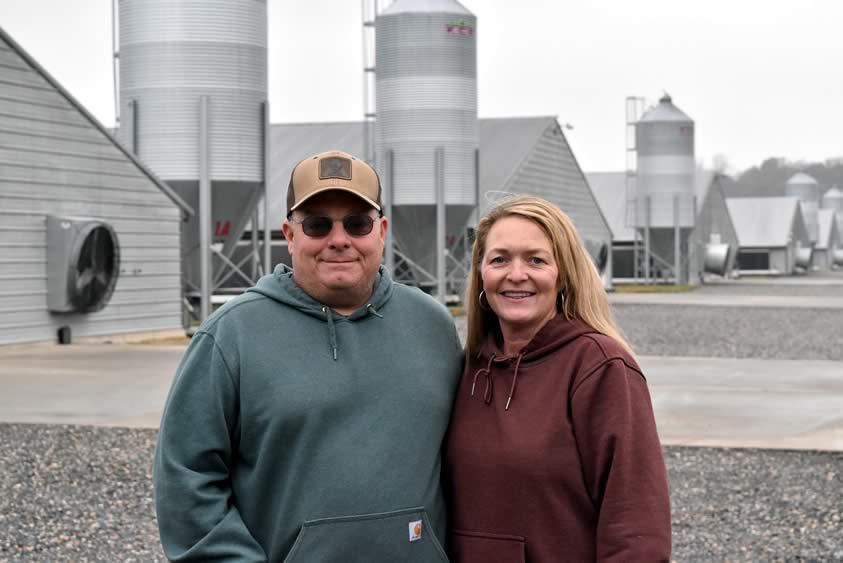
Family farmers Ben and Kayla Dilworth of Denton, Md. Their farm, which won an environmental award in 2025, is one 1,225 independent family farms raising meat chickens on Delmarva.
About Delmarva Chicken Association
Delmarva Chicken Association, founded in 1948, is the Delmarva chicken industry's voice as the premier membership association focusing on advocacy, education and member relations. DCA's vision is to be the most-respected chicken organization in the United States. For more information about the Delmarva Chicken Association, visit www.dcachicken.com or call 302-856-9037.